
11. March 2026
Ross Mitchell, Re. 100
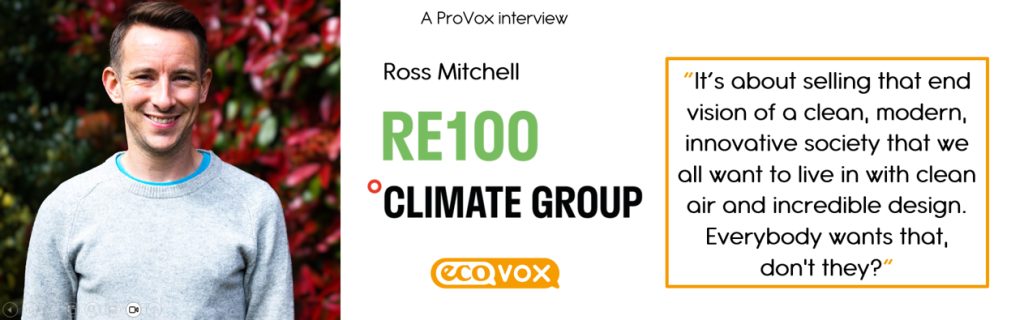
EcoVox: Can you tell us about the work Re 100 does and what your role is here as well, please?
RE100 is a corporate commitment campaign to 100% renewable electricity. When a company joins, they commit to that across their entire operations and they need to achieve it before 2050. We are working in the geographies, that our members find most challenging to source renewables, to make it possible for them to achieve that. I deal with the funding of the campaign, governance of the campaign, and making sure that the team can collaborate successfully together.
EcoVox: We're going to start with some icebreaker questions. Have you seen any good films lately or anything else cultural that had an interesting slant on environmental issues?
The last environmental thing I saw was David Attenborough's Ocean. I just remember it being really harrowing, but I think you need some of that shock and awe to get people to move. And it really speaks to how interlinked everything is on this planet. The ocean really is a barometer, for our health as a planet.
EcoVox: Are you reading anything that's taught you or made you think differently about anything?
I'm reading Oliver Burkeman. Four Thousand Weeks was his first book. That's how much time we've got on this planet as a human being and it's about using that time effectively and making sure that you use it as you want to use it. I'm reading his second book, Meditation for Mortals and it's trying to operationalise some of that. At the core of these books is that you are a finite human being and you need to realise that and recognise your limits in order to live an effective life. You can only do so much. You cannot care about everything and everyone. I think it very much speaks to sustainability: choose your battles, but really go for it with the ones you do choose. I would highly recommend it. It was really perspective shifting for me.
EcoVox: Our research shows that people are focussed on conservation, but of their own resources. Now, I'm presuming that economy and efficiency are the lead arguments you make for getting corporates on board?
When I started at Climate Group on the RE100 campaign, people were starting to respond well to the sustainability narrative. Companies really wanted to be seen as leaders in this space, and they realised that consumers saw it as important for them. But, in this complicated geopolitical climate, we're now seeing some companies shy away from this narrative. We're having to return to the original arguments that RE100 was founded on in 2014 and dust off some of our old messaging around cost and economic efficiency. There was a report that Climate Group did with Capgemini back in 2018 and it found that RE 100 members were 0.3% to 7.7% more likely to be more profitable, depending on their sector. There is a clear economic case, and maybe we should refresh that research, because I think those arguments are more important in this kind of environment.

EcoVox: in your own personal life what are you doing to reduce your own impact and reduce your spending at the same time?
I bought my own flat last year and it's got a smart thermostat and I love it, because it learns. Tonight, I'm going to my jujitsu class, so it won't turn the heating on. It synchs with your phone, knows when you're nearby or you're coming home and so switches on the heating. I won't spend anything on heating tonight when I'm not there, so it avoids wasted resources and money.
EcoVox: In the current political climate, this argument that only systemic change led by government can impact feels very disempowering. What really interests me about you guys is how you've got a different approach and you're trying to use corporates to force government's hands in a way.
Back in 2014, people just didn’t know if there was a market for renewables, so it was about demonstrating that market. We've got over 440 companies committed to 100% renewables and they are looking to transition the whole of their global operations to renewables. So, if you don't have good renewables access in your country, you're not going to get RE100 businesses locate their, bringing their foreign investment. For example, we launched in Indonesia two years ago and we've got 133 global companies that need their operations there to go renewable before 2050. So that's the pressure we're using in countries like that. And we've got all the others that aren’t yet located there, from the 440 that would likely move into Indonesia if they had a cleaner grid and could easily meet their renewables targets there. So that's the carrot piece that we're offering with the membership and the commitment – making the case to countries where your company finds it hard to source renewables collectively, which is so much stronger than making the case alone.
EcoVox: one thing we argue is that people want messages that are visible, tangible and feel immediate. What kind of messaging are you using for clients?
Some companies just want the validity of the RE100 commitment. We partner with CDP, who manage the technical side of the initiative. All of our members report to us annually on how they are performing against their target, so stakeholders like investors can see that their commitment is credible. In the boardroom, saving money is a critical argument. Being in better control of your own energy through renewables and not the energy markets, puts you in much better control of your business costs and also makes you more resilient in the face of price shocks. Some companies want to get involved in our policy work – where we’re working with policy makers to unlock easy and affordable corporate sourcing of renewables. So the arguments are varied and need to be tailored to a companies priorities but there’s always one that’s valid.
EcoVox: We're definitely facing down some big challenges, and there's lots of frightening statistics out there. How do you make your clients feel that they are part of a bigger movement that’s positive and cumulative?
Climate group runs Climate Week New York and the Climate Group Asia Action Summit, where we bring together all of our network – both business and government leaders. We share and celebrate what we've done over the past year and the key changes that we've seen enacted as a result of our work. We also hold the RE100 Leadership Awards at Climate Week, celebrating various things like community engagement, for example. One that always sticks with me is when Chanel won the Best Community Changemaker award for its work in expanding renewables to disadvantaged communities. This really brings the RE100 commitment to life and demonstrates the positive impact it can create, helping them to meet their RE100 commitment whilst transforming people's lives. It was an incredible story and showed that renewables can be much more than just a balance sheet exercise. It brings more of a human understanding to the benefit of the commitment.
EcoVox: Despite the bluster and the backtracking, do you think that governments in secret realise that renewables are inevitably where the investment is going and where the jobs are coming from?
I think so. You definitely see it in places like the new geographies that we're working in. So in Indonesia or South Africa for example, the government is very aware that this is where the future is, so they want to upscale and make sure they've got reliable renewable facilities to bring in those global corporates and the accompanying foreign investment. They don't want to be left behind. Asia's quite interesting because there's a lot of competing countries at a similar stage, all scrambling for this foreign investment. Lego - I think it was two years ago - did a beauty parade of countries in Asia where they were looking to locate a new factory. They ended up choosing Vietnam because it had the best renewables regulation and they knew they could easily power their facility with 100% renewable electricity.
EcoVox: In the West, we’re hung up on this fake heritage around fossil fuels, where they’re part of our tradition. It’s interesting that the traction is coming from Asia and it’s leapfrogging that.
Exactly. And China's gunning for it, right now. They brought more renewables online last year than the whole world combined. They're really cornering the renewables supply chain markets in the process, as they know that’s where the future is. It's a real economic opportunity and they've leapt on that, so they're going to reap the rewards.

EcoVox: I'm exploring this idea that “sustainability” has become a dirty word. I'm playing devil's advocate here, but for some people, it seems elitist or expensive. Could you give me a word you would use instead?
I would probably say something like, reciprocity: realising we're part of a much bigger system and realising that we need to support and look after that system rather than exploit it.
ExcoVox: There’s a sense that climate deniers have captured the “freedom” agenda for themselves. How do we make climate action or responsibility rebellious, cool and about sticking it to the man?
It’s about selling that end vision of a clean, modern, innovative society that we all want to live in with clean air and incredible design. I think that's quite compelling if we can tell it properly and make it aspirational, because everybody wants that, don't they? To live in that kind of clean, modern, innovative place.
EcoVox: This is a big one. Who or what gives you hope for the future?
It's obviously going to be energy related. We're seeing the hockey stick graph of the energy transition really play out and everything's clicking into place. Energy is where three quarters of emissions come from so this is really powerful. AI is going to be a big challenge because of the amount of energy it consumes, but I'm still really hopeful that we can reach net zero by 2050. Our understanding is now so much more sophisticated and the ingenuity of humans is moving us to a place where we're really understanding our place as part of a natural system. I think you're starting to see it with green cities integrating into natural systems. It's a race against time, but I think the energy transition shows me that incredibly quickly once it's unlocked.
For more information on RE100 and Climate Group www.there100.org
If your company would like to be a ProVox interviewee please get in touch